What to wear for paragliding near Marrakech, season by season
You need less than you think, but the wrong shoes can spoil the morning. Here is what to put on, and what to leave behind.
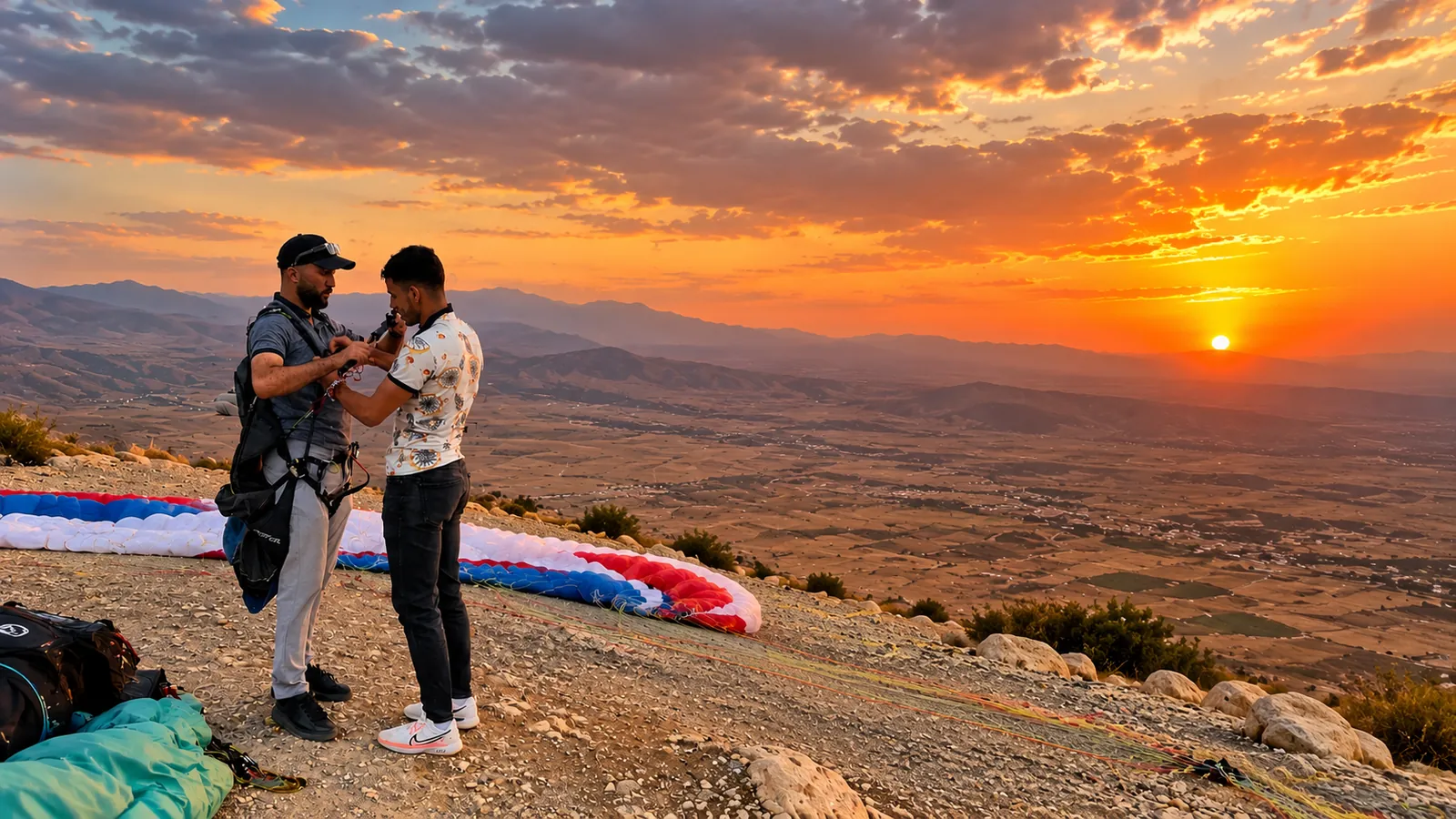
A tandem flight asks very little of you. We give you the harness and the helmet, and the pilot flies the wing. Your job is to arrive dressed for a rough hillside and a cool breeze, even on days when Marrakech feels hot. If you are booking tandem paragliding near Marrakech for the first time, this is the list to read the evening before.
The short list
- Closed shoes that stay on your feet. Sandals do not work here.
- Long trousers.
- A light wind jacket, in every season.
- Sunglasses.
- A hat for the wait on the ground. You wear our helmet in the air.
- In winter, a warm layer and gloves as well.
Why the shoes matter most
You use your feet twice. At take-off you walk two or three steps down the slope until the harness takes your weight. At landing the pilot tells you to stand up a few seconds before you touch the ground, and you walk out of it. Both moments happen on uneven ground, so you want a shoe with a real sole and laces you have tied properly.
Trainers are fine. Light hiking shoes are fine too. You do not need to buy boots for this. Avoid flip-flops, open sandals and anything you have to curl your toes to keep on, because a shoe that comes off in the air is gone.
Why it feels cooler at take-off
The weather station in Marrakech sits at 464 metres. Our take-off on the Aguergour ridge is at about 1,100 metres, so you start roughly 640 metres higher than the city. In the standard atmosphere model used by NASA, air temperature falls by about 6.5 °C for every 1,000 metres. On paper, that makes the ridge around 4 °C cooler than the city.
Real days differ from the model, and the moving air makes it feel colder than the number says. This is the reason a jacket stays on the list in warm months. You can always tie it round your waist while you wait.
What to wear in each season
| Season | Mean temperature in Marrakech | What works on the ridge |
|---|---|---|
| Winter (Dec to Feb) | 12 to 14 °C | Warm layer, wind jacket, gloves |
| Spring (Mar to May) | 17 to 22 °C | Long sleeves and a light jacket |
| Summer (Jun to Aug) | 25 to 29 °C | Thin long sleeves and a very light wind layer, for an early or late flight |
| Autumn (Sep to Nov) | 17 to 25 °C | Layers you can add as the months get cooler |
These temperatures are monthly means from the climate normals published by the Japan Meteorological Agency. They describe a typical month in the city, so check the forecast the day before you fly. You will find every month, with rainfall, in our month-by-month climate guide.
What to leave in the car
Bags, loose objects and anything that is not attached to you stay on the ground. Our pilots have a simple way of explaining this: phones fall from 300 metres very well. If you want to keep a phone on you, use a pocket that closes, and ask the pilot first.
Leave the selfie stick too. The passenger care course notes of the Swiss federation rule out selfie sticks and helmet cameras for passengers because of the injury risk. That is a Swiss teaching document and not a Moroccan rule, but the reasoning holds on any hill. If you want pictures, ask for the pole camera that the pilot holds, which is one of the options you can add to the 600 MAD flight.
Tie long hair back so it fits under the helmet, and tuck in scarves or anything that can flap. If you wear glasses, use a strap or a pair you would not mind losing.
The morning of the flight
We confirm your time the evening before, once we have looked at the weather on the ridge. Then plan half a day. Eat something light, bring water and put on sun cream before you leave, because you may wait in the sun before your turn. If you feel nervous or your stomach is unsure, tell the pilot. He can keep the flight straight and calm, with no turns at all.
For the order of events once you reach the hill, read how the morning unfolds from 4x4 to landing. For the road itself, we have a separate note on the drive from Marrakech to Aguergour.
Three questions we get about clothes
Can I fly in shorts in July? We ask for long trousers. The harness straps sit against your legs, and you may be sitting on rough ground while you wait. Thin trousers are enough.
What about a dress or a skirt? Change first. You sit in a harness with straps around the legs, and a dress will be uncomfortable from the first minute.
What should children wear? The same list, with extra attention to shoes that stay on and a jacket that closes. Our guide for first-time flyers covers the rest of the day, and the limits for younger passengers are in our note on weight and age.


